Portfolio Exposure and Trading Income
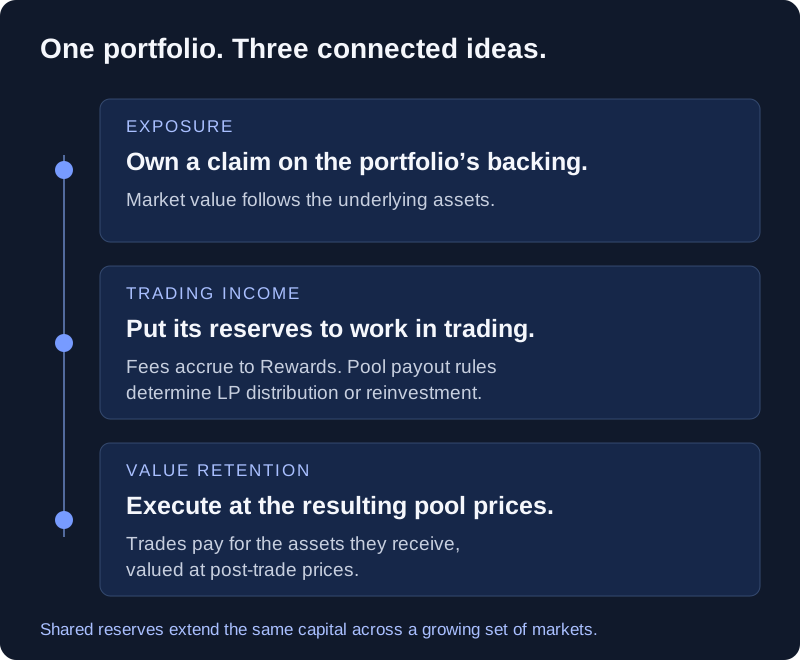
Multiswap gives a portfolio a trading market. Its LP Token represents exposure to the pool’s backing, while exchanges among its assets generate trading income. Trades pay the pool the full value of the assets they receive, valued at post-trade prices. Trading fees generate income on top.
Own the portfolio
Providing liquidity to an LP-owned pool issues LP Tokens. Those tokens represent a claim on the backing held by the pool. A stablecoin portfolio provides exposure to its dollar-linked assets; an equity portfolio provides exposure to its registered stock tokens under their issuer terms.
The portfolio evolves as trading changes reserves and accounting scales. Its weights follow from the resulting state. Liquidity operations determine how LP Tokens are issued and redeemed.
Earn from trading activity
The portfolio’s reserves also serve as trading capital. Each exchange can generate a receive-asset fee, and the current settlement implementation credits that fee to the receiving asset’s Rewards account.
This is the source of trading income. LP yield is the portion distributed to LPs or reinvested for their benefit under the pool’s reward policy. Activity, fee rates, portfolio size, and distribution rules determine the realized yield over a period.
Market exposure and trading income contribute separately to the economics of holding the position. A portfolio can earn trading income while its underlying assets change in market value.
Retain value through execution
Suppose a trader pays asset A and receives asset B. At the prices after the trade, the A received by the pool pays for the B delivered to the trader. Trading fees are additional income.
The pool receives payment for the full value of the assets it supplies, measured at post-trade prices. Trading fees generate income on top. Receive fees and Surplus contributions have explicit accounting entries.
The valuation is the pool’s post-trade valuation. Returns measured in dollars also reflect external asset prices, portfolio composition, and the timing of liquidity actions.
Read Post-Trade Execution for the value-flow identity and Fees and Surplus for the settlement accounts.
Put the same capital to work across more markets
Each reserve participates in every pair containing its asset. As the pool’s asset universe expands, that capital serves a growing set of trading markets. This creates more venues for activity within the same portfolio.
Capital efficiency describes this reuse and the execution capacity supported by the reserves. Realized income depends on the trades that actually occur. Capital Efficiency explains the relationship.
Read the deployment’s earnings rules
The current implementation records receive fees in Rewards. Eligible Surplus settlement additionally allocates a share of pay assets to Rewards and Treasury. These accounts have distinct purposes and balances.
The reviewed swap and staking modules expose fee accrual and stake allocation. LP distribution, reinvestment, eligibility, and claim timing require an explicit payout mechanism and published pool terms. Assess those details when evaluating a live yield product.
USD.cav on Robinhood Testnet demonstrates the portfolio and trading mechanics with demonstration assets. Its quotes and Rewards accounting provide a way to inspect how the pieces work together.